Showing posts with label conservation. Show all posts

Thursday, June 05, 2008

REFURBISHMENT & RESTORATION: historical buildings in the centre of Rome

In a city such as Rome a vast proportion of refurbishments take place within historical buildings. Obiously protected by conservation laws, these buildings are also safeguarded by the inborne love of historical detail present in most Italian architects. Interestingly, in Italian the words "refurbishment" and "restoration" have virtually idential meanings and there is a single translation for both terms: "restauro". The framework of each project is set by the historical value of the structure. This however in no way limits the immagination and capacity for experimentation of some young architects. While searching for a valid example of a small scale project to demostrate the work of young Roman architects I noticed this 60 sq m space developed into a studio by a young Roman architect, Carola Vannini. Here an old store space under the arches in Piazza Vittorio (in the area of Rome known as the Esquilino) has been restored with great understanding of past, present and world trends.

Wednesday, March 12, 2008

DOORS & WINDOWS: back to basics

Successful interior design needs to be based on the "skin and bones" of a house. The structure, fixtures and fittings are often left unquestioned. These subconsciously but immediately inform our initial perception of our surroundings. On a more practical level, a hollow poorly fitted door provides little sound insulation just as an inexpensive or badly maintained window causes the same problem as well as allowing heat loss.
I work mainly on listed buildings and properties within conservation areas where the replacement of windows usually has to be implemented on a strictly like-for-like basis (i.e. timber for timber, sash for sash, with allowances made for modern sealed glazing units). There are many firms out there offering the benefits of sealed glazed units applied to traditional timber window designs. Having spotted their "conservation range" I recently contacted Mumford & Wood who are assisting me with the planned replacement of Georgian style sash windows. I will post once "before & after" comparisons are available.

Where doors are concerned there is often more scope for choice as the rules are somewhat less stringent (in non-listed buildings of course). In an ideal world no expense would be spared. If the budget allows for this I would not hesitate in contacting Longden whose doors grace many of the top developments in central London.
Should the budget only stretch as far as an improvement, I would at least consider solid paneled doors, oak if possible (in spite of the tradition for pine where painted doors are being specified). As always, when savings have to be made, one's understanding of doors will be tested far more than it would be if the made-to-measure route were an option:
1. the sizes of existing door openings will dictate whether standard sizes will fit;
2. some doors will more than likely have to be fire rated and sourcing these to match the style of the non rated doors is not quite as easy as it sounds;
3. as a result a combination of made-to-measure and standard sizes often ends up being the only possible way forward.

So what do all these different types of doors cost?
One shortcut to the answer is provided by this table available on the GreenSpec web site. The purpose of the table is to assess the cost of each type of door and its maintenance over a 60 year period and therefore needs to beread with its scope in mind. The background research provides however, at the time of writing, a good indication of how much each door will cost you (although fitting and decorating costs have probably undoubtedly increased since).

Thursday, July 12, 2007

CONSERVATION: hurdles and concepts

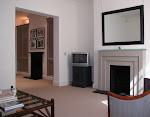
Listed buildings, houses within a conservation area: issues one deals with repeatedly specially when working in central London. However, at least in my case, it is true to say that one is often guilty of not addressing the "concept", simply aiming at the "result". For some reason, a Chelsea mock-Georgian house has allowed me the time to notice my shallow approach. I've been trawling the internet and talking to people about the whole idea of conservation boundaries. Picket fences around buildings deemed to be of note (often by non-specialised professionals who possibly are unsure about exactly.... which note). Electric fences around sections of somebody's home which, therefore, they only partially own. More like a person whose destiny one can never totally control, than like a house - a material possession which can be moulded around wishes and made to conform to our plans.
An article* by Julian Holder points out how distinctly anthropomorphic are most of the concepts applied to buildings by conservation enthusiasts. "Can a building really be 'compromised', its 'integrity' questioned, its 'character' altered?" He adds that "to accept the[se] concepts ensures that all the participants are already treating buildings as people, as living breathing beings, whose fate we care about, and not simply as bricks and lime mortar. At its best it is a linguistic slight of hand....... At its worst it is a transparently bullying misappropriation which fails to impress the hard headed and leaves conservation looking distinctly amateur".
I must confess that the house which started this whole thought process is, indeed, one of those houses one would describe as "honest". Clearly not in the human sense of the word; more so to describe its simple declaration of intents. My view is that remaining identical to oneself is not necessarily the ideal state for man-kind. I therefore doubt this can be ideal for a utilitarian, perfectly coherent, teen ager (if house years are worth half as much as dog years) of a residential property.


* The Building Conservation Directory 2001 http://www.buildingconservation.com/articles/pdf_concept/concept.pdf
General descriptions: listed building and conservation area. http://www.buildingconservation.com/articles/conplng/conplng.htm